QdZ · Open Ledger Books · First edition, 2026
The Book
What changed in India, and what didn’t.
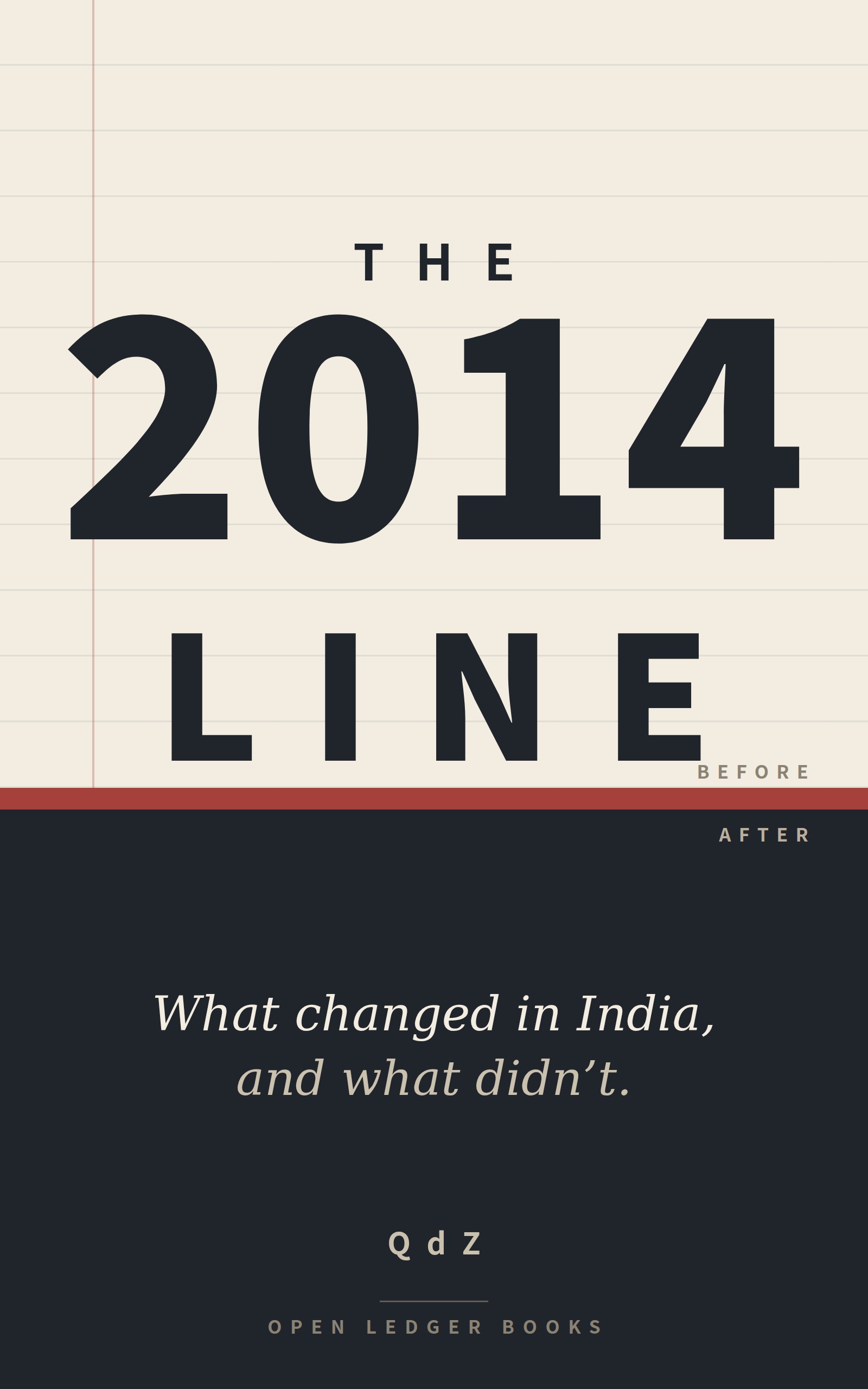
For those who were children when the line was drawn.
You inherited the argument. Here is the evidence.
“Long years ago we made a tryst with destiny, and now the time comes when we shall redeem our pledge…”— Jawaharlal Nehru, 14 August 1947
Introduction: The Laminated Square
At a roadside tea stall in almost any Indian town, the most consequential object is a laminated square of paper taped to the counter. A vendor who may never have stood inside a bank branch now runs her till through it. Ten rupees for a glass of chai: scanned, settled, gone. No coins counted, no khata entry, no queue. In 2013, this transaction did not exist. Today, India carries out close to half of the world's instant digital payments — about 49 per cent, by industry counts.
Somewhere behind that square of paper sits the argument that has consumed India for a decade. One side says 2014 was the year India finally began. The year files started moving, toilets got built, terrorists got answered, and a civilisation stopped apologising for itself. The other side says 2014 was the year something broke. The year institutions bent, neighbours learned fear, and a noisy, plural republic began speaking in one approved voice. Both sides are absolutely certain. Both cannot be fully right.
This book is written for the reader who suspects the truth is neither a tribute nor an obituary — and who is tired of being handed one or the other.
The method is simple enough to state in three questions, asked of every sector in turn. What was true before 2014? What is true after? And what does the best available evidence say about the difference? Where the numbers are solid, you will get them with their sources named in the sentence, not buried in a footnote. Where the numbers are themselves the battlefield — and after 2014, the fight over statistics became part of the story — you will get the dispute laid out whole. A country arguing about its own scorecard is itself evidence of the era.
Two rules govern every page. First, no era starts from zero. The UPI miracle runs on an identity system born in 2009. The 1991 liberalisation was signed by a Congress government. The highways of the 2000s were a BJP project. Honest accounting credits each. Second, the verdict is never mine. By the last chapter you will have the ledger. What you write at the bottom of it is your business — that is, after all, the whole idea of the republic both sides claim to be defending.
How This Book Keeps Score
Every chapter of this book is scored by six rules. They are stated in full in Chapter 6, where the 2014 handover is audited. Here they are in brief, so you can hold the book to them from page one.
Rule 1 — No zero baselines. Every achievement is measured against the trendline it inherited, not against nothing. Continuity is credited to its authors, whichever party they were.
Rule 2 — Luck is separated from policy. Oil windfalls, global booms, pandemics and wars are logged before any government is graded — this one exactly as the last one.
Rule 3 — Promises are yardsticks. A government that dates a promise — double farm incomes by 2022, a developed India by 2047 — has chosen its own ruler. It is measured by it.
Rule 4 — Outputs are not outcomes. Toilets built versus toilets used. Taps installed versus water flowing. Where the two numbers differ, you get both.
Rule 5 — The ruler itself is contested; you get the range. GDP series, jobs surveys, hunger indexes and death counts became battlefields after 2014. Where credible sources disagree, this book prints the spread and names each side. Never one convenient number.
Rule 6 — One standard. For violence, for captured institutions, for hidden data, for the treatment of critics: the same test for every era, every party, every community. No side gets a home umpire.
One more promise. Every term is explained the first time it appears — GST, NPA, MSP, collegium, waqf, transshipment, all of them — in plain words, in the sentence itself. If you ever need to read a line twice, the fault is this book's, not yours.
A Note on Money and Measures
This book counts the way India counts. A lakh is 100,000 — one followed by five zeroes. A crore is 100 lakh, or ten million. So ₹1 lakh crore — a figure that appears often in this book — is one trillion rupees. As a rough guide across these years, ₹1 lakh crore is about 12 billion US dollars, and ₹85–90 buy one dollar. A quintal is 100 kilos. Indian words that carry their own meaning — mandi, langar, labharthi, jugaad — are kept, and explained where they first appear.
Sources: How This Book Was Checked
This book was written against a simple rule: every statistic traces to a source named in the text itself, at the sentence where it appears — not in a footnote you will never visit.
The spine of the sourcing is official and primary: the RBI, the NSO and its surveys, Budget and Economic Survey documents, the Election Commission, the NCRB, CAG reports, Parliament's own question replies, Supreme Court judgments, and the international bodies — World Bank, IMF, WHO — where they are the standard ruler. Government claims made through press releases are used, and are labelled as government claims. Index rankings — press freedom, democracy, hunger — are used with the government's objections to their methods printed alongside, every time.
Three habits of this book deserve a word of explanation. First, the ranges: where credible sources conflict — GDP growth, COVID deaths, jobs — the book prints the spread and names whose number is whose, because choosing one would be taking a side. Second, the phrase "no data is maintained": it appears in this book many times, always quoted from the government's own replies to Parliament. Where the state declined to count, the book says so, and prints the independent counts beside the silence. Third, the composites: the recurring characters are invented people built from documented realities — surveys, field studies, reportage — so that the numbers are experienced before they are argued. Nothing a composite lives through is invented in substance.
Facts in this book are current to August 2026. A small number of fast-moving items — court cases, trial runs, moving totals — are marked in the text with the honest phrase "as this book went to verification." Corrections are welcome and will be made: this book's credibility is its only argument. Notices reach the publisher, Open Ledger Books, through the book's store page.
Author's Note
I did not write this book to change your mind. I wrote it because I could no longer find the book I wanted to read: one that would tell me, plainly and fairly, what actually changed in India after 2014 — and what only looks like it did.
I wrote it, above all, for readers younger than the argument itself. If you are twenty as this book goes to print, you were eight in 2014. You have never seen an India that was not already shouting about that year. Everyone around you knows the verdict; almost nobody can show you the file. This book is the file.
I write under a pen name, and that is deliberate. A book that promises no side deserves an author who cannot be sorted into one. QdZ has no politics you can look up. Only these pages, and their sources, answer for me.
Every reader deserves to know how a book was made. This one was researched and written in partnership with an artificial-intelligence assistant, working under my direction. The division of labour was constant throughout: the AI researched, drafted, and checked; I set the rules, chose the questions, reviewed every claim, and hold final responsibility for every sentence. Facts were verified against the named sources during writing, chapter by chapter, and a written verification log was kept for all twenty-four chapters. Where a number could not be pinned to a source, it was cut or printed as a range. The fairness discipline — both sides at full strength, no verdict pushed — was the standing instruction from the first page, and enforcing it was my job.
I make no apology for the method, and I hide nothing about it. Tools change; the standard does not: what is printed here must be true, sourced, and fair, and the name on the cover — mine — is the one answerable for it.
The verdict, as the introduction promised, was never mine to give. It is yours.
— QdZ, August 2026
Copyright and notes
© 2026 QdZ. All rights reserved. Published by Open Ledger Books. First edition.
The information in this book is current to August 2026, and every effort has been made to verify it against the sources named in the text. Interpretations are attributed to those who hold them; errors that reach the publisher will be corrected in future editions.
This is a work of nonfiction. The recurring characters — Savitri, Ashok, Meena, Balwinder, Ravi, Shameena, Harbans, Ganesh, Meera, Ramesh, Aslam, Rekha, Ramdas, Anjali, Iqbal, Ramkali and their families — are composites: invented individuals assembled from thousands of documented, real accounts. No composite depicts a real person. Every public figure, event, and number is real and sourced.
Contents
- Part One — The Inheritance (1947–2014): Chapters 1–6
- Chapter 7 — Money: The Economy at Full Volume
- Chapter 8 — Banks: Cleaning the Stable
- Chapter 9 — The Phone in Every Hand: Digital India
- Chapter 10 — Concrete: Highways, Rails, Wires, Taps
- Chapter 11 — Welfare, Rewired
- Chapter 12 — The Farm: Where Change Broke
- Chapter 13 — Work: The Jobs Question
- Chapter 14 — The World: Foreign Policy Finds Its Elbow
- Chapter 15 — The Gun: Defence and Kashmir
- Chapter 16 — The Machine: Politics After 2014
- Chapter 17 — The Referee: Institutions Under Strain
- Chapter 18 — The Temple and the Republic
- Chapter 19 — The Classroom and the Clinic
- Chapter 20 — The Sun and the Furnace: Energy and Climate
- Chapter 21 — The Lab and the Launchpad
- Chapter 22 — Five Lives
- Chapter 23 — The Scoreboard
- Chapter 24 — The Second Tryst: 2047
- Glossary · People · Timeline · Toolkit · Quiz